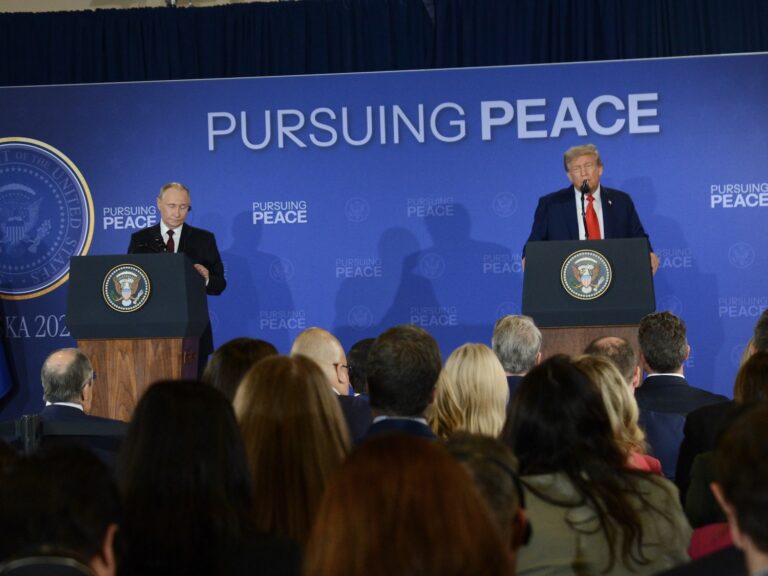
A Symbol-Heavy Summit, Light on Substance
The summit on August 15, 2025, at Joint Base Elmendorf-Richardson in Anchorage, Alaska, brought Trump and Putin face-to-face for just under three hours, followed by a short joint statement—no press questions permitted Al JazeeraWikipediaThe Washington PostAP News.
Trump characterized the meeting as “extremely productive” and indicated multiple points were agreed upon, though one major sticking point remained unresolved Al JazeeraThe IndependentDeutsche WelleThe Washington Post. Both leaders expressed willingness to meet again—Putin even teased, “Next time, in Moscow” Al JazeeraThe IndependentThe TimesAP News.
Putin’s Position
Putin reiterated the familiar Russian framing—that sustainable peace must eliminate the “root causes” of the war, interpreted as Ukraine’s NATO ties and Western military support Al JazeeraThe IndependentDeutsche WelleThe GuardianAP News. Russian officials later presented the summit as a “starting point” for resolving the conflict—though no detailed proposals were publicized TASSThe Economic TimesAnadolu Ajansı.
Trump’s Response and Agenda Shift
Originally pressing for a ceasefire, Trump pivoted mid-summit toward a broader “peace agreement,” stating that a ceasefire alone often fails to hold The Washington Post+1AP News. Post-summit, he noted that peace now depends on Ukraine’s willingness to negotiate and territorial concessions, particularly in the Donbas region The Washington Post+1WikipediaReutersThe GuardianThe Sun.
Trump also downplayed sanctions, delaying new punitive measures despite earlier threats The Washington Post+1ReutersAP News.
Business and Diplomacy
Though initially Trump insisted business talks would follow progress on peace, Putin later remarked they discussed cooperation in technologies, space, Arctic ventures, rare earth minerals, and trade Al JazeeraIzvestiaBrookingsAP News—a sign that economic diplomacy was gaining ground alongside or instead of conflict resolution.
Why the War Still Rages On
No Ceasefire, No Security Guarantees
No agreement was reached on a ceasefire, with Putin refusing to drop his preconditions The Washington Post+1AP NewsDeutsche Welle. Ukraine insists a ceasefire must come first, while Russia demands territorial and diplomatic concessions—creating a standoff that undermines peace negotiations ReutersThe GuardianThe Washington PostWikipediaThe Sun.
Legitimacy and Leadership Conflicts
Putin continues to cast Zelenskyy as unreliable or illegitimate, complicating any trilateral meeting efforts The GuardianThe Sun. Without a strong Ukraine-U.S. alignment, negotiations lack coherence and trust.
Propaganda-Packed Optics
The summit was widely seen as a propaganda victory for Putin—Alaska symbolized a return to global legitimacy, and Trump’s warm reception played into that narrative The IndependentThe Washington PostAP NewsThe Australianeuronews.
U.S. Policy Ambiguity
Trump’s shifting message—moving from ceasefire ultimatum to peace deal flexibility, and from sanctions to restraint—created ambiguity. This weakened U.S. negotiating leverage and emboldened Russian tactics The Washington Post+1TIMEThe AustralianReuters. European leaders and Ukraine remain skeptical of his direction The GuardianTIMEThe Sun.
Continued Hostilities
Meanwhile, Russia continues military offensives, further destabilizing the situation ReutersThe GuardianAP News. Putin’s refusal to budge, paired with Ukraine’s firm resistance, traps both sides in a brutal and unresolved stalemate.
Summary Overview
| Aspect | Details |
|---|---|
| Key Topics Discussed | Root causes of the conflict, security arrangements, potential business cooperation (tech, space, Arctic resources), future summits |
| Main Obstacle | Divergent demands—Putin demands dismantling of Ukraine’s NATO ties and Western support, Ukraine demands ceasefire and security guarantees |
| Why War Continues | No ceasefire deal, conflicting narratives, lack of trust, Trump’s mixed messaging, persistent battlefield hostilities |
| Outlook | Summit served more diplomatic theater than tangible progress; peace remains elusive without serious concessions and third-party mediation |
Despite moments of cordial diplomacy and symbolic potential, the Alaska summit failed to produce the ceasefire or peace framework that could truly end the war. With core issues left unresolved—territorial integrity, security, legitimacy, and unity among Western allies—the conflict continues to rage on.